In Early Years, physical development is about much more than burning off energy. It is the foundation for everything from concentration to early writing. Across Pre-Nursery, Nursery and Reception, we nurture both gross motor skills (large, whole-body movements) and fine motor skills (small, precise hand and finger movements) every single day.
The two of these areas go hand in hand. Children need strong shoulders, cores, and balance before they can control the tiny muscles in their fingers. Alongside this, we also encourage ‘risky play’ where children are given safe opportunities to test their limits, assess challenges and build resilience. Here is how that journey looks for us across Early Years.
In Pre-Nursery, our youngest learners are discovering what their bodies can do. By climbing, crawling through tunnels, and dancing with scarves, they build their core stability and spatial awareness. Engaging in risky play, like stepping over low uneven logs or sliding down the slopes, teaches them how to judge distance, recover from wobbles and build early physical confidence. At the tables, chunky crayons, playdough squishing and canvas painting help build small muscles in their hands.
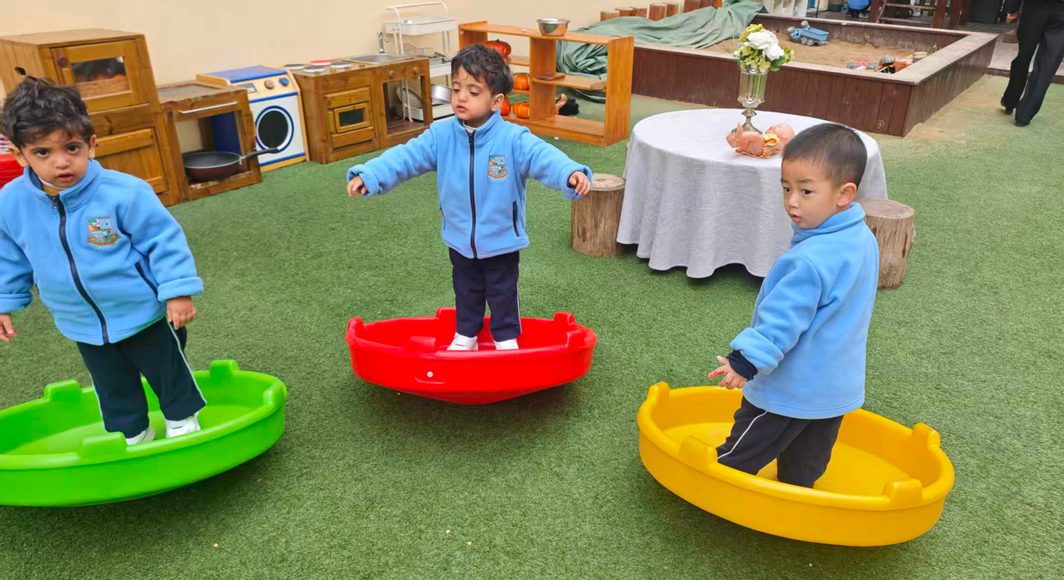
As confidence grows in Nursery, the children refine their balance and coordination, navigating obstacles when running around, pedaling bikes and catching large balls. In their risky play, they are balancing on beams, navigating challenges on the climbing frame and building their own obstacle courses to challenge themselves. Children are developing their fine motor skills by threading beads, using scissors and manipulating tweezers, all of which build the hand strength for future tool use.
In Reception, gross motor play becomes more complex, involving skipping, hopping and team games that require agility and control. Children are learning to ride bikes and scooters at faster speeds, navigating obstacles and tight corners. They are moving heavy crates and planks to build obstacle courses and testing the stability of them together. During focused PE lessons, they have been learning how to jump on and off objects of different heights, safely controlling their landings. Fine motor skills focus on intricate control, from cutting curved shapes and building with interlocking bricks to developing a comfortable tripod grip for letter formation and detailed drawings.
Much of this physical growth happens outside the classroom walls and in our messy play areas. Uneven surfaces, like grass, logs and climbing frames, naturally challenge children’s balance in ways indoor flat floors cannot. Sensory trays filled with sand, dried beans, water and mud act as an unconscious workout. Scooping heavy wet sand builds shoulder stability, while pinching small beans or squeezing water from sponges develops finger dexterity and strength.
Developing gross motor and fine motor skills is something that happens at school and at home. Letting children carry a small bag of shopping, peel their own orange, practice walking along low garden walls or even helping to prepare food are simple, screen-free ways to build strength, confidence and coordination together.
Lauren Olsen
Nursery Teacher
Head of EYFS