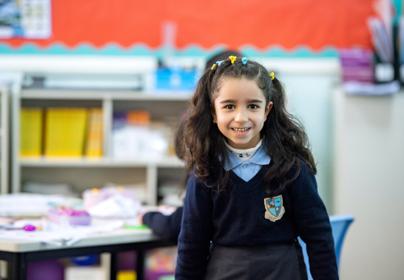
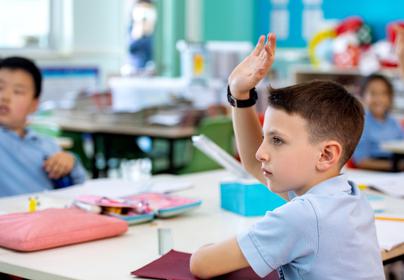
Last week, Britannica students joined more than 4 million worldwide taking part in the Bebras Challenge, the world's biggest school-level computational thinking competition conceived by Professor Valentina Dagienè to get young people interested in computer science.
Taking its name from the Lithuanian word for 'beaver', in a nod to the animal's intelligent and hardworking nature, the challenge currently runs in 78 countries, and tests key skills such as pattern recognition, decomposition, abstraction, and algorithmic reasoning.
Organised in the UK by the Raspberry Pi Foundation in collaboration with the University of Oxford, students work through different sets of real-world computer science problems under timed conditions, with questions pitched according to age. Each puzzle builds students' computational thinking: breaking a problem into smaller parts, spotting patterns, thinking logically, and designing step-by-step solutions, skills that are embedded across our Secondary Computer Science curriculum and, in particular, in our units on programming.
Many of the questions also cover ideas from our units of work on algorithms and data representation, which students learn from Year 8, and include searching and sorting, following and tracing algorithms, and how information is stored in binary.
Students who achieve high scores in Bebras may be invited to take part in the Raspbery Pi Coding Challenge later in the school year, a 45-minute activity where students write programs to solve computational thinking problems using languages such as Blocky, Python, and C.
Well done to everyone who took part!
Connie Westoby
Teacher of Computer Science